Showing posts with label Operator Vodafone. Show all posts

Sunday, 24 November 2019

5G CrowdCell: World's First 5G OpenRAN Small Cell

I explained about Open RAN in a tutorial here. In the recent TIP Summit, there was a lot of discussion of Open RAN. In their presentation, Miguel Marin, Technology Director, AMAP, Vodafone talked about world's first 5G OpenRAN small cell. Known as the crowdcell, it can be seen in the picture below.


I wrote about Crowdcell earlier here. While it was more in an initial stage then, it is already working and under trials in Turkey. The video below shows a demo of crowdcell from TIP Summit 2019


You can learn more about CrowdCell on TIP website here.

This video from Lime Microsystems from last TIP Summit explains the CrowdCell concept.

TIP Summit 2018 from Lime Microsystems on Vimeo.

It should be borne in mind that the TIP website says that CrowdCell is intended for extending indoor coverage. Sprint's / Airspan's MagicBox is solving exactly the same issue. You can read more about that here. The only real difference here is that CrowdCell is based on OpenRAN architecture and principles.

Parallel Wireless has a similar solution for outdoors. You can read more about that here and here.

Related Posts and Articles:

Wednesday, 17 April 2019

Vodafone UK improving coverage with Phone Boxes, Mini-masts & Manhole Covers


Scott Petty, CTO of Vodafone UK wrote a post about how 'our cunningly imaginative network team has devised some ingenious ways of boosting mobile reception.' While readers of this blog will have already seen most of these innovations from around the world on our blog, it's nevertheless an important step to bring connectivity to users in rural and remote areas that suffer digital exclusion.

Late last year, Vodafone talked about how their mini masts (picture on top) are making huge differences to JCB Staffordshire quarries. Around half the height of a standard mast, the mini masts can be painted to fit in with the local surroundings. The masts also require less power and electronic equipment.  This means they are ideally suited to providing a mobile signal in hard-to-reach rural business locations, such as the two JCB sites, near its World Headquarters. The mini mast is developed in partnership with infrastructure technology company Commscope according to the PR.

Continuing from the original PR:


4G networks can easily become congested in densely populated cities. This is especially true for urban areas regularly visited by waves of tourists, such as London’s Covent Garden. Fitting a mini-mast to the underside of a manhole cover to increase mobile coverage may sound bizarre, but it makes perfect sense. Our incredibly fast fibre optic network runs beneath the streets of Covent Garden and provides the bandwidth muscle behind our manhole cover mini-masts. Each mini-mast isn’t designed to boost coverage for all of London or even the West End, but for specific stretches of Covent Garden where overwhelming demand for a strong and stable 4G signal would otherwise go unmet.

But manhole cover mini-masts won’t be appropriate or possible in every locality. For some places, such as Edinburgh’s historic Princes Street, mini-masts built into phone boxes make more sense. These converted phone boxes not only provide a boost to mobile reception on this bustling thoroughfare, but help preserve a much-loved icon of our national urban heritage.

In a post back in December, I wrote about Small Cells in Phone Boxes here.

In another press release yesterday, Vodafone said:

Picture source: ThinkSmallCell

Visitors to the popular seaside resorts of Polzeath and Sennen Cove in Cornwall this Easter can now receive fast mobile Internet and great voice reception along the beach after Vodafone installed the latest 4G technology in beachfront phone boxes.

Mobile coverage can often be difficult to provide in remote areas and coastal locations due to the local topography and the lack of power and fibre cables needed to link up masts. Vodafone is continually looking at new ways of providing customers with great coverage, including by installing 4G technology into traditional phone boxes, returning them to their roots.

Beach-goers will not only be able to use their smartphones on Vodafone’s ‘4G from a phone box’ service within approximately a 200-metre radius. They can also make use of Vodafone’s range of connected devices, including the V-Pet Tracker to help you pinpoint a dog that has wandered off.

Vodafone is working on a number of initiatives to help support the Government’s ambition of extending mobile coverage to 95% of UK landmass by 2022. In addition to drawing up industry-wide proposals to create a single rural network to cover not spots and partial not spots, last year, Vodafone achieved an industry first by installing the UK’s first mini mobile mast at Porthcurno in Cornwall.


The Cornish 4G-enabled phone boxes are equipped to cope with the increase in mobile usage over the Easter break and over the summer months. During the heatwave in 2018, our network in Cornwall carried nearly 90% more mobile Internet traffic than the previous year.

Vodafone is also testing 4G in phone boxes in busy shopping areas in Edinburgh, Oxford and soon in London. At its technology headquarters in Newbury, Berkshire, Vodafone is trialling housing 4G on the underside of manhole covers.

All pictures, unless mentioned are from Vodafone.

Related posts:


Tuesday, 11 December 2018

Small Cells in BT Phone Boxes

Picture Source: Andy Sutton

In a news announcement yesterday, Vodafone said that they are planning to install 4G and 5G equipment to the underside of thousands of manhole covers across Britain to boost connection speeds in the busiest urban areas and meet the public’s insatiable demand for mobile data.

According to the report, Vodafone, which has hundreds of thousands of Cable & Wireless-branded manholes as part of its network, has developed the subterranean plan alongside Swedish telecoms equipment group Ericsson. The system is known internally as The Vault.

Attaching antenna equipment to the base of a manhole cover can boost the signal across a 200-metre radius, according to Vodafone, and could be critical in supporting future “smart city” technologies such as connected traffic lights. Installation does not require planning permission, which speeds up network build.

Vodafone and Ericsson have developed two types of system. One attaches equipment to the base of existing Victorian-era cast iron manhole covers. Another is a bespoke reinforced unit the size of a water butt that is sunk into the ground underneath a purpose-built cover.

We have blogged about Small cells infrastructure underground and in manhole covers. The following posts are related to that:
Phone boxes, which are connected to the power supply, are a useful tool to boost demand on high streets and in rural areas. Vodafone has signed a deal with BT’s wholesale division to install 4G antennas in phone boxes, and has kitted out one on Edinburgh’s Princes Street to improve coverage in time for the Hogmanay celebrations on New Year’s Eve.

The picture on the top from Andy Sutton is from Small Cells World Summit back in may. He says, "New life for old kiosks, KX100+ accommodating a 4G LTE small cell for enhancing mobile area capacity density"


ThinkSmallCell has a nice picture of the top of the KX100+ phone booth. In it's report on the Small Cells World Summit 2018, David Chambers says the following:

BT had the largest demo with a full size telephone box equipped with a small cell hidden in the roof space. Although only one Nokia small cell was fitted, the unit could accommodate several from different network operators. Each site is backhaul with either 100Mbps or 1Gbps managed Ethernet and transmits above head height using an omnidirectional antenna. It would seem we will shortly be making phone calls from telephone boxes again, just without realising it.

It would be interesting to see some more of these old phone boxes converted into small cell towers.

See also:
Here is a tweet containing picture of Ericsson's vault radio system for anyone interested:

Saturday, 29 September 2018

Vodafone Australia trialing regional coverage hub (small cell) with Nokia


Vodafone Australia has unveiled its new technology for helping improve mobile signal for voice, data, and Internet of Things (IoT) in regional areas, with its Vodafone Regional Coverage Hub. The Hub is a simple, self-install, small cells solution. It relies on ethernet backhaul for connectivity with the operator network.

ZDNet reports that this has been developed in partnership with Nokia. Nokia has a similar solution called Kuha that they have trialed in UK.

Vodafone press release mentions that this hub was able to provide coverage for 8 sq. km., which is roughly 1.5 km radius. Its a low power solution so coverage area would be restricted. The small cell is providing 4G and NB-IoT coverage.

Its interesting to note that as this is 4G only, older 4G devices and devices that do not support VoLTE will not work on this small cell. 

Tuesday, 20 March 2018

CrowdCell heads for TIP

Recently I wrote about Facebook's Telecom Infra Project (TIP) here. The following is from a recent announcement coinciding with MWC:

In our existing project groups, there are numerous TIP technologies that are moving from the lab stage to field and production trials. Each trial has operator sponsorship and includes key members of our technology ecosystem. Together, these TIP teams are working to validate technologies, share learnings, and accelerate toward commercialization at scale. Simultaneously, TIP members are contributing designs and specifications for new technologies and building new network tools.

Our TIP community is also growing and expanding in scope to address new challenges. Over the last month, TIP has added three new project groups and subgroups: Crowd Cell, Power and Connectivity, and Disaggregated Cell Site Gateways. At MWC, we are also announcing a new TIP community lab near BT’s Adastral Park campus in the UK and more than €100 million in venture capital funding available for infrastructure-focused startups participating in the TIP Ecosystem Acceleration Center (TEAC) in Germany.

In addition, we are excited to welcome some of TIP’s newest members: China Unicom, Sprint, and Telenor. They join more than 500 companies around the world that are active within TIP.
...

Crowd Cell is a new project group led by Vodafone. Crowd Cell is a concept based on relay architecture to help extend the range of existing cellular networks. Due to its plug-and-play design, Crowd Cell can be a rapid and low-cost small cell solution for traditional 4G networks. This project will focus on creating a Crowd Cell by leveraging generic hardware and open source designs for software to minimize costs through this “one design” flexible platform.
...


I blogged about the CrowdCell concept back in 2016 here. Then there were updates on the CrowdCell at MWC 2017 which I blogged here. This year, as the TIP announcement says, Vodafone is taking the CrowdCell to Telecom Infra Project. The following is from Vodafone's announcement:

Vodafone is developing new technologies designed to enable the cost-effective deployment of base stations in currently unconnected areas of Africa and India. The deployment will be supported by Vodafone’s new Open RAN technology and Facebook’s OpenCellular wireless access platform, which were developed within the Telecom Infra Project (TIP).

Open RAN technology significantly reduces the costs of rolling out networks in rural areas, fundamentally improving the economics of providing data and voice services to millions of unconnected people.  This new approach is expected to reduce the cost of radio network equipment by up to a third.

Vodafone also believes Open RAN technology will jump-start the establishment of an end-to-end industry of software and hardware vendors and integrators that will drive innovation, which is critical for achieving such a complex endeavour.

Picture Source: Michael Thelen

Vodafone has already conducted successful trials in India with two new vendors that have developed bespoke high-power base stations using software-defined radio and general purpose hardware based on Vodafone’s specifications and support. Wider scale trials are planned for later in 2018 where up to 200 sites will be equipped with the new technology. Tests are also currently ongoing in South Africa with TIP´s OpenCellular platform for 2G and 4G services.

This OpenCellular technology is being showcased at Vodafone’s booth at Mobile World Congress 2018.

Vodafone joined the TIP board in November 2017 and is a founding member and co-chair of TIP’s Open RAN project group, which aims to develop fully programmable RAN solutions based on general purpose processing hardware and disaggregated software. TIP is an engineering-focused initiative driven by operators, suppliers, integrators and startups to disaggregate the traditional network deployment approach.

The acceleration and expansion of this collaborative trend – embodied by TIP – will lead to significant change in the telecom industry and provide the ability to connect millions of people in rural communities for the first time.

Other TIP initiatives in which Vodafone is playing a major role include:
  • Vodafone is leading a TIP working group to develop a new, open version of CrowdCell. The award-winning CrowdCell technology – developed by Vodafone’s Networks Centre of Excellence in Madrid – makes networks more “localised” to deliver faster download speeds and enhance the network’s reliability. For more information: http://www.vodafone.com/content/index/what/technology-blog/crowdcell.html
  • Beyond radio, Vodafone and TIP are working together with Cumulus, Zeetta Networks and the University of Bristol’s High Performance Networks Group on evolving Voyager, the industry’s first white-box transponder and routing solution. Vodafone will demonstrate Voyager’s capabilities in a trial in April.
  • Vodafone is also founding a new TIP sub-group within the Open Optical & Packet Transport project group focused on transport on disaggregated cell site gateways. Similar to the gateways in radio, these would reduce the current vendor lock-in that operators face in transport networks. Cell site gateways will be also based on off-the-shelf hardware, open software and interfaces on a technology agnostic platform.

Here is a slide deck that I prepared and shared on 3G4G blog here. The part embedded below starts from Vodafone section.


Happy to hear your views on TIP or Vodafone's CrowdCell announcement. Please add them as comments.

Wednesday, 8 November 2017

Vodafone Portugal's “streetlamp”


Vodafone Portugal, in partnership with Drivetel, Omniflow and Amop is deploying its own “streetlamp” to improve coverage and capacity in certain areas while at the same time making sure the antennas blend in with the surroundings.


From Linkedin (via Cliff Velosa):

In Portugal Vodafone is committed on reducing visual impact on outdoor (rural and urban) coverage and made sure that the energy resource consumption is engage to a better and efficient way.

Comba Telecom has played an important role together with Drivetel S.A to the construction of a clean and unique system with a camouflaged Tri-Sector antenna that supports LTE1800 and WCDMA coverage and fits just perfectly to the rest of the environment.


A smart street light 100% self-powered by Wind and Solar energy and supported by a local Portuguese Company called OmniFlow.

It’s a completely integrated solution that blends into the most modern urban Smart Cities and to the wildest landscape. The generated energy with natural resources can contribuite to Vodafone's Pico/Micro/Small cell NB/eNB Base stations energy supply that is environmental friendly and contributes to the local population not only on mobile coverage and services but also served as public lights during the night.

The infrastructure is all underground with only the antennas on the top.

In another Linkedin post (via Cliff Velosa):

One of Portugal’s sea viewpoint – Santa Cruz beach, the local municipality together with Vodafone agreed on a efficient way to supply mobile radio coverage and capacity on Wi-Fi, 3G and 4G with an independent lighting system which produces enough electricity for the lighting system throughout the night by using natural resources (wind and sun), saving extra costs on the municipality, the tax payers will thank them in the long term.

A local Portuguese company did the design of the base bench foundation in concrete that meets the concerns of vandal resistance, life cycle and with reserved space to add all the RF RRU's/BBU's inside a the cabinet and with a spot around the tower to sit and navigate on Vodafone’s high speed broadband. No more ugly towers with massive antennas, Comba's Camouflaged 3 Cluster antenna did just the trick to reduce that impact.

This new “streetlamp” reduces the time to setup the tower and offering radio service to Vodafone's customers in matter of hours knowing that everything is setup by Drivetel in advance before transporting the system to the field.

All picture sources: Cliff Velosa

Further Reading:


Tuesday, 8 August 2017

Exploding Femtocells: How Testing plays an important role


The Register pointed out a while back that some of Vodafone's Sure Signal Femtocells (designed by Alcatel-Lucent) are exploding.
Vodafone says that anxious customers of its home femtocell box are safe, despite experiencing continuing brownouts. Although Vodafone is replacing the Alcatel-made units on request, it has declined to carry out a full recall.
Vodafone's user forums have a lot of info and pictures. The one from which I took the above picture says:
The failure was announced by a loud bang, a flash and the tripping of the power circuit.
Luckily there has been no serious accidents but it is enough to highlight the importance of all the different kind of testing that is done for all different kinds of devices.


This picture above, even though highlights the testing for mobile devices, is not very different to the steps required or testing small cells.

Due to the pressures of delivering more is shorter duration's, it can sometimes be a challenge to finish all of these to the highest possible standards. In any case, if its not done in the right way, the end results are visible soon enough, once it goes live.

Saturday, 3 June 2017

Temporary masts for festivals, events, etc.


I really enjoyed watching couple of video's from Peter Clarke of temporary masts that are installed at events like Glastonbury festival and other high profile events.  They are both embedded below:


If you enjoyed, check out more videos like these on his Youtube channel here.

Sunday, 28 May 2017

Small Cell Forum Awards 2017 Winners


The Small Cells Forum (SCF) Awards 2017 were recently held as part of Small Cells World Summit. The Small Cell Industry Awards are a recognized badge of excellence and innovation with a panel of impartial judges – comprised of analysts, journalists and industry experts – ensure the independence and quality of the awards. Its one of the few awards that I really respect for its impartiality.

The award nominees can be viewed here and the winners are here. The photographs are available here. I have covered some of the winners as part of this blog so I am listing those posts below.

Parallel Wireless & Gilat Parallel Wireless and Gilat Connecting the Unconnected in the Outback - I wrote this post 'Small Cells to help connect Australian Outback'. There is a very good video, unfortunately cant be embedded on this news item here.

Parallel Wireless Removing Deployment Constraints of Small Cell vRAN and 5G HetNets - I have not directly covered this topic, but will do soon. This post from last year 'HetNets On The Bus' gives an idea on how the HetNet Gateway (HNG) removes deployment constraints and future proof the network. Interested readers can find more detailed info on Parallel Wireless website here.

Vodafone CrowdCell: Using Macro Radio Network to Backhaul Open-Access Small Cells - I have covered this as part of 'Small Cells at Mobile World Congress 2017' and earlier 'Vehicular CrowdCell or Vehicular Small Cell and the 5G plan'

BT & EE EE Air Mast Using Small Cells - This is my favourite as I was personally involved in this activity. I have two posts on this one. The first one is 'Flying Small Cells are here...' and the second one is 'Connecting Rural Scotland using Airmasts and Droneways'. I have to admit that this is a very ambitious project, especially the second one.

*Full Disclosure: I work for Parallel Wireless as a Solutions Architect. This blog is maintained in my personal capacity and expresses my own views, not the views of my employer or anyone else. Anyone who knows me well would know this.

Thursday, 18 May 2017

Loon powered emergency networks for flood affected Peru


In the past, when earthquake and floods used to take out mobile connectivity, satellite used to be the only way forward. See here for instance for use of satellite connectivity in Nepal and Japan. I really like the Network in a backpack from Vodafone picture in that post.

Having said that, things have moved on in the last few years. In my earlier post I discussed about Telefonica's network in a box that weighs just 40 grams. This can be deployed in conjunction with a drone or a Helikite and you have a self-contained coverage. EE is taking this further and plans to connect Scotland using Airmasts and Droneways.


In the recent floods in Peru, Telefonica worked with Google Loon team to to re-connect the service and re-establish mobile communications, which are particularly crucial in such dire circumstances. According to their blog:
Telefónica and Project Loon brought basic Internet connectivity across more than 40,000 Km2, providing over 160 GB worth of data –enough to send and receive roughly 30 million WhatsApp messages, or 2 million emails.
The Google Loon team have their own blog posts on this topic here and here.

The picture on the top is a modified picture from Project Loon that explains how the Loon's work. Fundamentally the working is sort of the same, regardless of the technology you use. As I explained in my other post here, when you use Helikites for example and create a mesh network its similar to the Loon's using laser for connectivity between them. All technologies need backhaul to connect to the outside world and access to connect to the end user.

Further reading:


Friday, 10 March 2017

Small Cells at Mobile World Congress 2017 (#MWC17)


Mobile World Congress was big and busy, as always. There were lots of interesting demos, technologies and much more. While I was only able to look at a few demos, here is my summary of the small cells related info that I managed to see or came across on social media.

Ericsson and Philips have been working together for a while so its no surprise they were showing their new connected street lighting model. You can see this from my picture above.

Sprint has already mentioned earlier that they will be rolling out more small cells and they were conveying the same message at MWC. Their rival T-Mobile says that they have 1000 small cells right now but will have 5/6000 by the end of the year.

IP Access had a nice booth and it was good to see that their CEO Malcolm Gordon and CTO Nick Johnson both managed to get their message across that 2017 will probably be a big year for Small Cells.


Vodafone introduced the "CrowdCell" concept last year, this year they continued to build on that story. The CrowdCell uses macro for backhaul. I generally refer to this as In-band backhaul (IBBH) and have written about this here. While they have already shown Indoor CrowdCell and In-car CrowdCell before, this year they were showing the Flying CrowdCell. You can see a video of that here (in Spanish) and a non-flying version here. This is slightly similar to the Airmast concept by EE.


Hidden in a corner at the Vodafone booth was a pre-commercial quad band femto by Parallel Wireless. If you look at the form factor, its no different than a single band femto from couple of years back.


Parallel Wireless also had a presence on many of their partners booths (picture above from KMW booth). TMN magazine has a feature on them and I embed their video below.


China Unicom is deploying 500 Radio Dots from Ericsson in Beijing.

Cellnex was showing how their small cells could be used for Smart Cities and Urban deployments. They have recently signed contract with JCDecaux and expects to deploy between 200,000 and 500,000 small cells ðŸ™ƒ

Acceleran was showing small cells on 3.5GHz CBRS band.

The Indian mobile operator Reliance Jio, which recently set a record for fastest 100 million subscribers (in 170 days), will be deploying Airspan small cells. This should be a massive project for Airspan.


Finally, there were quite a few 5G conceptual demo's. The picture above is from Intel stand. Due to 5G not yet defined, people were either using 28GHz or 60GHz. Regardless of what they were demonstrating, they would claim it to be 5G.

Apologies to other vendors I have missed.


There were also some good presentations at the Small Cell Forum networking area. The link for them is below and I will also be sharing some more of them in the coming weeks.

Related links:

Saturday, 9 July 2016

MEC, Small Cells & IoT

Here is a presentation from Vodafone on how Mobile Edge Computing and Small Cells can play a big role in Internet of Things.

Vint Cerf, who is universally recognised as one of the founding fathers of Internet recently said that there will be 1 Trillion devices on the net by 2036, many of them being IoT devices.

This presentation also lays out use cases for IoT. As always, I am interested in hearing your thoughts.


Friday, 26 February 2016

"Vehicular CrowdCell" or "Vehicular Small Cell" and the 5G plan


In the recent Mobile World Congress, Vodafone and BMW introduced the Vehicular CrowdCell concept, a small cell providing coverage in the car when people are in it and outside when the car is parked. The presentation is embedded later on in the post.


The following is from the BMW press release:

...the BMW Group is unveiling the research project “Vehicular CrowdCell”. This project extends the concept of the “Vehicular Small Cell” presented last year in Barcelona. While the “Vehicular Small Cell” is a mobile femtocell that optimises the mobile radio reception inside vehicles, it is now also capable to enhance the capacity and coverage of mobile radio networks. The BMW Group is teaming up with peiker and Nash Technologies to present a prototype of the “Vehicular CrowdCell” integrated into a BMW research vehicle.

The rapid growth of mobile data traffic, e.g. due to the increasing use of multi-media services such as music or video streaming with mobile devices, requires even more powerful mobile radio networks in the future. One strategy to increase the capacity and coverage of future networks is the integration of a large number of small cells and relays in addition to the existing base stations.

In 2015 the BMW Group, together with its partners peiker and Nash Technologies, presented the world’s first mobile femtocell in a vehicle. The “Vehicular Small Cell” optimises the reception available to mobile devices inside vehicles via the vehicle’s aerial. Now the concept has been extended to create the “Vehicular CrowdCell”. Based on data traffic and coverage demands, the mobile femtocells are dynamically activated to locally enhance mobile radio networks.

The benefits of Vehicular CrowdCells in practice.
One possible application of “Vehicular CrowdCells” are car-sharing fleets – in particular with electric vehicles. Here, a large number of vehicles spread over cities and regions could serve as local radio relays when parked. If one or more users are located close to a mobile femtocell, it is activated on demand in order to increase the bandwidth or provide additional network coverage. In such a way, the performance of the existing network can be dynamically optimized. Benefits for mobile phone users in hotspots include a higher data rate and the absence of reception white spots – especially in areas where the signal coverage is low.

“The “Vehicular Small Cell” will optimise in-vehicle connectivity of mobile devices for our customers,” explains Dr. Peter Fertl, project manager at the BMW Group. “At the same time, the integration into a network of “Vehicular CrowdCells” will enable the ubiquitous and seamless availability of high-quality mobile radio connections outside the vehicle as well.”

Nash innovations have more details about the earlier version of this, The "Vehicular Small Cell" here and here.

Before we go any further, check out the Vodafone presentation embedded below:


I wrote a blog on this topic back in May 2014 here. In that article I mentioned that for a small cell in the car, the biggest challenge is backhaul. One approach is to use one particular frequency for backhauling to the small cell and then the small cells output another frequency. This approach was mentioned in another blog post here. In this approach, TD-LTE was used for backhaul and it created an FDD LTE small cell inside the train.

Why do I think this kind of approach work with 5G. In my other post about 5G spectrum, I mentioned that 5G will need multiple frequencies. Low frequencies for coverage, high frequencies for capacity and very high frequencies for very high speed throughput's. Because the very high frequencies, do not travel very far as compared to the low frequencies (with the same power), beamforming would be used. These very high frequency beams can be directed towards the Vehicular small cells, which in turn would create a much larger cell at a lower frequency.

This approach would typically only be used in urban environments as in rural areas there is plenty of unused spectrum (until more uses are found - quite possible with the IoT device explosion). The small cells would also need advanced sensing and SON capability to work in harmony with the macro network.

If you have an opinion, feel free to add it in the comments section.

Saturday, 4 July 2015

Disguising Small Cells in Rural areas

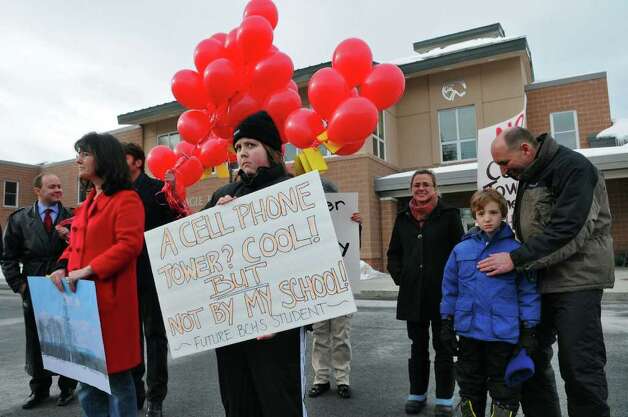
Bethlehem Middle School student Jeremy Luzinski, center, holds a sign Sunday to protest the planned construction of a cell phone tower a few hundred feet from the Eagle Elementary School, which is behind him, in Bethlehem. ( Philip Kamrass / Times Union ) Photo: PHILIP KAMRASS

We all want good mobile coverage but we do not want the cell towers in our backyard. The main reason being that somehow this can affect our health and maybe cause cancer. There is absolutely no link between cellphone radiation and cancer as I have discussed in an earlier post here. With more studies having been done, any possible links between cellphone tower and existence of cancer seems to diminish. On the WHO list, exposure to radio emissions is now category 2b (possible carcinogens), along with coffee, talcum powder and many other substances to which we all expose ourselves.


As a result, the mobile operators have started disguising cell phone towers. A cellphone tower inside the bell tower, rear right, is seen over the Resurrection Lutheran Church in Ankeny, Iowa. In rural areas disguising also doesn't affect the scenery.


The cactus cell tower in Arizona is another great example of coverage by stealth.

antenna

Small cells on the other hand is a whole new ball game. We are so used to seeing WiFi routers that people will probably not bat an eyelid with the small cell above by Vodafone in Cranborne.


Another disguise is the bird box cell booster, also by Vodafone. It picks up the mobile signal from the nearest network mast, and boosts it to provide better coverage in the surrounding area. This would definitely fit with the surrounding but getting power can sometimes be tricky.

Do you know of any disguised small cells, please let us know.

Saturday, 2 May 2015

Emergency communication options in times of disaster

The Nepal disaster is another reminder that we need to be prepared in case of natural (or man-made) disasters and in times of emergencies.

ITU said that it has deployed emergency telecommunication equipment in Nepal following the 7.8 magnitude earthquake that hit the country on 25 April 2015. The emergency equipment includes 35 satellite mobile phones and 10 satellite Broadband Global Area Network terminals along with solar panels and laptops to support relief coordination efforts.

Satellite phones have been getting better with higher speeds. Thuraya Telecom has some interesting videos on Youtube, here is one that shows how to get good these phones have become:


Satellites can also be used to provide backhaul for small cells and can be installed relatively quickly.


Thaicom recently announced that they have sent equipment and engineers to help reconnect the region quickly. From a picture posted on their website, it looks like they are backhauling the small cells but I dont have any more details.

A similar approach is being done by another satellite operator SES, in conjunction with emergency.lu.

Drones (UAVs) and Baloons are another option for use in these scenarios but they need (expensive) receivers to be installed, which may be an issue.

One of the lessons learned after the Japanese twin disasters of earthquake and tsunami was the need to deploy more small cells.
According to Akiyoshi Ishiwata, a principal research analyst at Gartner in Tokyo covering Japan's mobile networks, 'each of the operators are actively installing small cells and picocells in buildings, subways and indoor areas'. These miniature basestations improve indoor coverage, and improve a network's resilience by using more diverse power supplies and backhaul connections. Ishiwata said operators are considering using femtocells as the basis of a national machine-to-machine communications network that could also include earthquake sensors.
Cabinet with fuel cell

According to The Register, DoCoMo has tested blackout-proof hydrogen cell base station in Japan, ready for the next tsunami (see picture above).

Finally, I saw this tweet about Vodafone's emergency 'network in a back pack'


Its not the first time Vodafone is helping out with a Small cell in a backpack. According to WSJ:
Vodafone Group said Monday its philanthropic division has created a mobile network in a backpack that can be deployed in 10 minutes, enabling aid workers to carry out their work in disaster zones. 
The Instant Network Mini, which can be taken as hand luggage on commercial flights, can provide up to five concurrent calls within a radius of about 330 feet and enable text messages to be sent to thousands of people. 
The 24-pound backpack is an innovation that follows on from the company’s original Instant Network—a portable network in a larger form that can be transported in four suitcases weighing 220 pounds. It offers a much wider operating radius of up to 3 miles.
Two original Instant Network kits were used in the Philippines during Typhoon Haiyan in November 2013, enabling 1.4 million text messages and 443,288 calls in 29 days, Vodafone says. 
The backpack, developed by Vodafone’s Spanish business, as well as Chinese telecommunications giant Huawei Technologies and nongovernment organization Télécoms Sans Frontières, provides a secure 2G GSM network, with a GSM base transceiver station connecting to a host network over a satellite connection. 
A 2G (short for second-generation) network can support voice calls and text messages but can’t easily handle Web surfing or video, unlike the 3G and 4G networks in wide consumer use.
In African countries, having a network allows people to use services like M-Pesa, for instant money transfers to friends and family. Vodafone has also donated £100,000 to support relief efforts following Nepal earthquake that killed more than 3,300 people.

Do let me know if I have missed anything.

Additional reading:

Sunday, 5 April 2015

Rural and Remote coverage back in spotlight

The Small Cell Forum recently launched its Release 5: Rural & Remote to address the growing concern of especially rural coverage that is plaguing many developed nations.


The release contains 16 new and updated documents ranging from case studies of small cells already used in a range of rural and remote settings, through to those covering backhaul, deployment challenges, architectures and the services that can be enabled by small cells.
From my point of view, backhaul is one of the biggest challenge for the rural and remote coverage. As I have discussed in an earlier post here, satellites are a good option for rural small cells. The main issue with satellites is latency which could be around 0.5 seconds which may make them unsuitable for voice and other real time applications. Another option being trialled are Balloons and Drones as I have discussed in another post here.

The Australian operator Telstra is rolling out small cells in around 50 rural areas. While the small cells would be good for 4G data, they wouldnt be available for voice. While I do not have the details on what backhaul they are using and the voice issues could be more of VoLTE support on handsets, I am sure the users would appreciate the data coverage. If latency is not an issue then they could use OTT services like Skype, Whatsapp, Viber for voice.

The UK operator EE has been working with Parallel Wireless to use innovative mesh backhauling. Part of the licensed spectrum (20MHz chunk of EE‘s 1800MHz LTE spectrum) could be used for backhaul which would be different from the access network for the end users. The meshing allows in theory for the small cell to macro connection, with a couple of hops, be as much as 30km.

As I have mentioned in a post earlier, Vodafone UK has its own Rural Sure Signal program. Vodafone claims to have received hundreds of applications from communities across the length and breadth of the UK. Following a trial covering 12 towns and villages, it has now announced the first 30 communities selected to join the programme, which it is hoped will enhance everyday life for consumers and make it easier to do business in rural areas. There is a plan to continue this program for the rest of this year.

ThinkSmallCell has an interesting article where it asks if the drive towards the rural coverage is operator driven or regulator mandated. While it is a combination of both is most developed countries, in some developing nations it can just be that people are desperate and will find their own way. One example is people in remote villages in Mexico that are installing open source base stations from NuRAN to provide coverage to their villages. Another example is Nepal, where villagers are banding together to provide WiFi coverage to rural areas.

Opensource is another concept argues ThinkSmallCell that may also be an opportunity to connect some of the most remote and unserved communities which commercial organisations haven't been able to reach. It may also be useful for experiments and for colleges and universities with limited budgets. PA consultants have shown how to create a 2G base station using Raspberry-Pi. I have a feeling that we will see more projects like these soon.

Monday, 14 October 2013

The right technology for different Enterprises

The enterprise deployments seem to be hotting up. Back in May, Telefonica O2, Germany, announced 'Signal Box', their enterprise femtocell based on UMTS to improve indoor coverage. Recently Vodafone in Netherlands announced that they are offering enterprise small cells from Spidercloud. There was an interesting article in Fierce Wireless about the enterprise small cells opportunity. The relevant part is reproduced below:

Friday, 22 March 2013

UK 'Not-spot' gets five Metrocells from Vodafone


View Larger Map

From Salisbury Journal:
LAST year, the village of Cranborne was selected as one of 12 communities UK-wide that would participate in a Vodafone pilot project to bring mobile telephone signal to rural “not-spot” areas.
Having successfully fulfilled the technical criteria for the trial, which included having no 2G or 3G signal and a sufficiently fast fixed-line broadband connection to support Vodafone’s new Open Femtocell technology, Vodafone engineers visited local businesses and community buildings in the centre of Cranborne to position five Metro Cells, each the size of a home broadband router, to give the best signal cover to the village.
The only cost to the trial community is the cost of power to each box.
In February the system was successfully installed and, earlier this month, the village celebrated the official launch of the technology.
North Dorset MP Robert Walter attended the launch. He said: “I am thrilled the new technology has been successfully installed and that, for the first time, businesses, residents and visitors can make and receive mobile telephone calls from the heart of the village. It is my sincere wish that the experience of these trials helps to deliver more solutions to rural areas affected by signal blackouts.
A good example of how Metrocells can solve coverage problem and may also future proof against capacity issues.